
Juab County Bench Warrants Explained
A Utah bench warrant is a court response to a missed appearance or failure to meet a court instruction. In Juab County, common triggers include missing a date printed on a citation, summons, arraignment notice, or court setting. A court may also issue one when a cited person fails to pay as the court permits.
Probation or contempt matters may create separate District Court issues. Juvenile matters follow restricted procedures and are not ordinary public warrant-list records. Check the court tied to the notice; a county search alone may not show the whole case history.
Juab County Uses Bench Warrant
Juab County and Utah court materials use “bench warrant” for citation nonappearance. They do not use “capias” or “capias pro fine” as the local public label. Those terms are common elsewhere, but importing them here could send a reader looking for the wrong form or court process.
For a Juab traffic ticket, the underlying matter can still be an infraction even when a missed date produces a bench warrant. Ask the clerk which obligation remains open and whether the judge wants an appearance.
How Juab County Bench Warrants Are Issued
Utah Rule 4B and Code §77-7-19 allow a judge to issue a bench warrant when a cited person fails to appear or pay as the court permits. The warrant comes from the court handling that case. It is tied to the missed obligation, not a new criminal charge by itself.
The clerk and court control the case record and any recall, reset, or payment order. The court sends updates to the statewide file; service details may come later from law enforcement. A BCI result is useful for routing, while the issuing clerk can confirm what is current.
Juab County Bench Warrants From Citation Dates
The county citation page gives at least five and no more than fourteen days to appear or contact the court. Mandatory-appearance tickets get an arraignment date by mail or email. If a hearing needs to move, Juab asks for notice as soon as possible and at least one day before the setting.
Missing that step can lead to a warrant. The county page says some citation information may take five business days to reach an online payment view, so do not wait for a screen to change before calling the court.
Utah's citation rule covers the court's nonappearance authority.
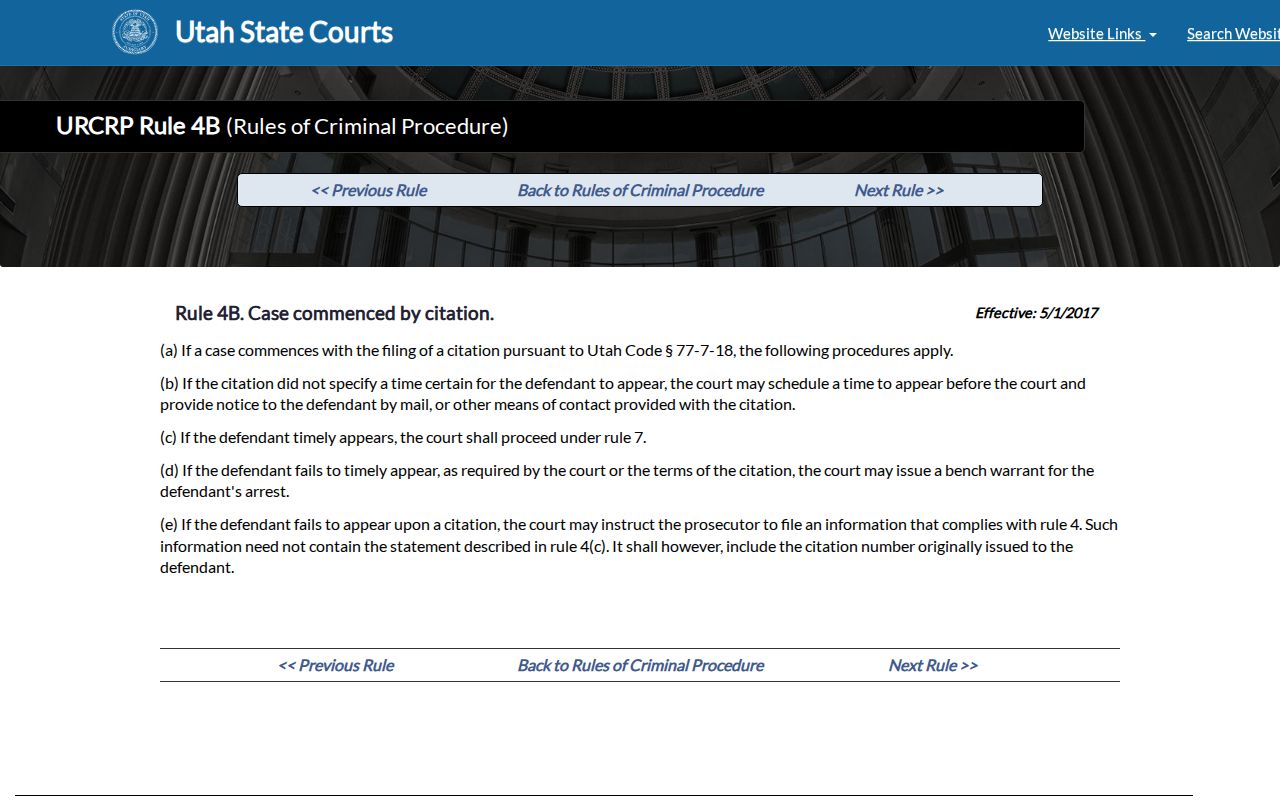
Use the rule as context, then follow the date and directions on the actual notice.
Bench Warrants and Arrest Warrants Compared
A bench warrant follows a court obligation that was missed. An arrest warrant follows a judge's probable-cause and necessity findings under Utah Code §77-7-5. Both can appear in statewide warrant information, but the first question is which court issued the order. For the separate probable-cause process, see Juab County arrest warrant records.
| Feature | Bench Warrant | Arrest Warrant |
|---|---|---|
| Trigger | Missed court date or failure to comply | Probable cause and a necessity finding |
| Who issues it | Judge in the pending case | Magistrate or judge |
| Underlying case | Existing citation or court matter | Charged offense or criminal case |
| Next step | Ask court about recall, reset, or appearance | Confirm court, counsel, and release terms |
Nephi's Part-Time City Court
Nephi City Justice Court holds court on Mondays, excluding holidays, and the city describes it as part time. Its page asks callers who reach voicemail to leave a message. The court phone is (435) 623-1263, and the public email is jcjuab@utcourts.gov.
A phone call is a way to ask about a case, not to pay by card. The city court page says no phone payment; it also describes an after-hours payment box in the courthouse hallway. Ask the clerk whether a payment would recall the specific warrant before sending money.
Nephi City Justice Court publishes its schedule and contact instructions.
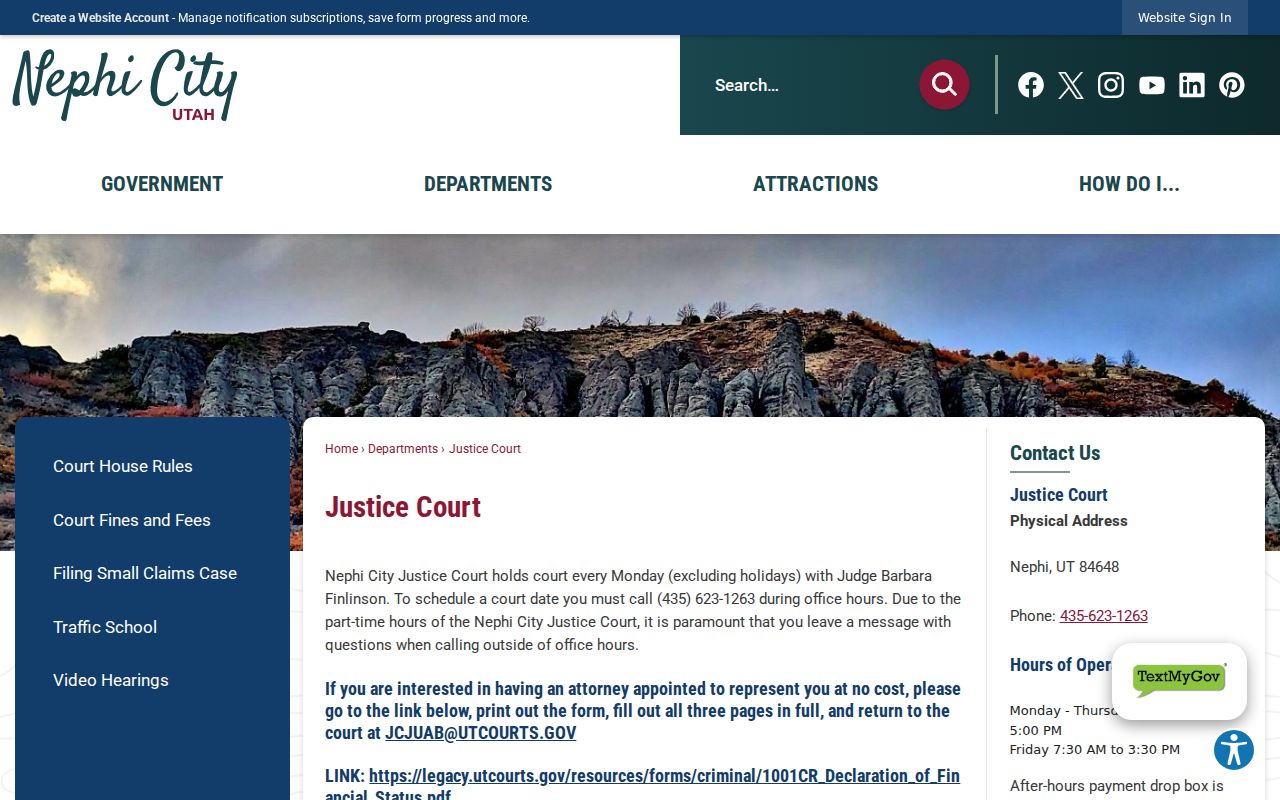
Nephi's city court is separate from the county Justice Court.
Resolving a Juab County Bench Warrant
Start by identifying the court and case number. Ask if the warrant is active, whether the judge requires a personal appearance, and whether payment, a motion, or a reset can address it. Juab has no public motion-to-recall form, warrant bond schedule, or walk-in surrender hours in the sources reviewed.
- Use BCI, the citation, or Xchange to identify the court and case number.
- Call that clerk and ask what the judge requires to recall or reset the warrant.
- Talk with counsel before a court appearance or any court-directed surrender.
- Complete the payment, new hearing, or other order, then ask the court to confirm the update.
Caution: A payment screen does not prove the warrant is recalled; get confirmation from the court that issued it.
A Juab County Bench Warrant Recall Leaves the Case Open
A court may recall a bench warrant or set a new date, but the original citation or criminal case can remain open. The next order may require an appearance, a payment plan, or another hearing. Ask the clerk what still needs to happen after the warrant status changes.
The BCI manual describes how court recalls reach UCJIS. After the judge acts, wait for the clerk's update guidance and then recheck the statewide search. A missing result does not dismiss the underlying matter.
Finding the Court That Issued the Warrant
The court that set the case controls its bench warrant. Fourth District Court handles felony and class A matters at (435) 623-0901. Juab County Justice Court handles county traffic, infractions, and class B/C cases at (435) 623-3440. Nephi City Justice Court handles city cases at (435) 623-1263.
Levan's separate Justice Court dissolved effective April 1, 2021, with cases transferred to Juab County Justice Court. If the paperwork predates that change, call the county clerk and give the old case number. The sheriff serves warrants but cannot set the court's recall terms.
Confirm a Juab Court Before a Warrant Visit
Juab court and sheriff offices sit at different Nephi addresses. District Court is at 102 E 200 N; the county and Nephi City Justice Courts are at 160 N Main; the Sheriff and jail are at 425 W Sheeplane Drive. Do not treat these as one counter.
Juab County Justice Court requires security screening, bars weapons and contraband, and limits recording. The jail checks visitors for warrants. Call the issuing clerk or counsel before traveling, and do not use an inmate visit as a way to ask about surrender.